AI - Friend or Foe?
AI - Friend or Foe?
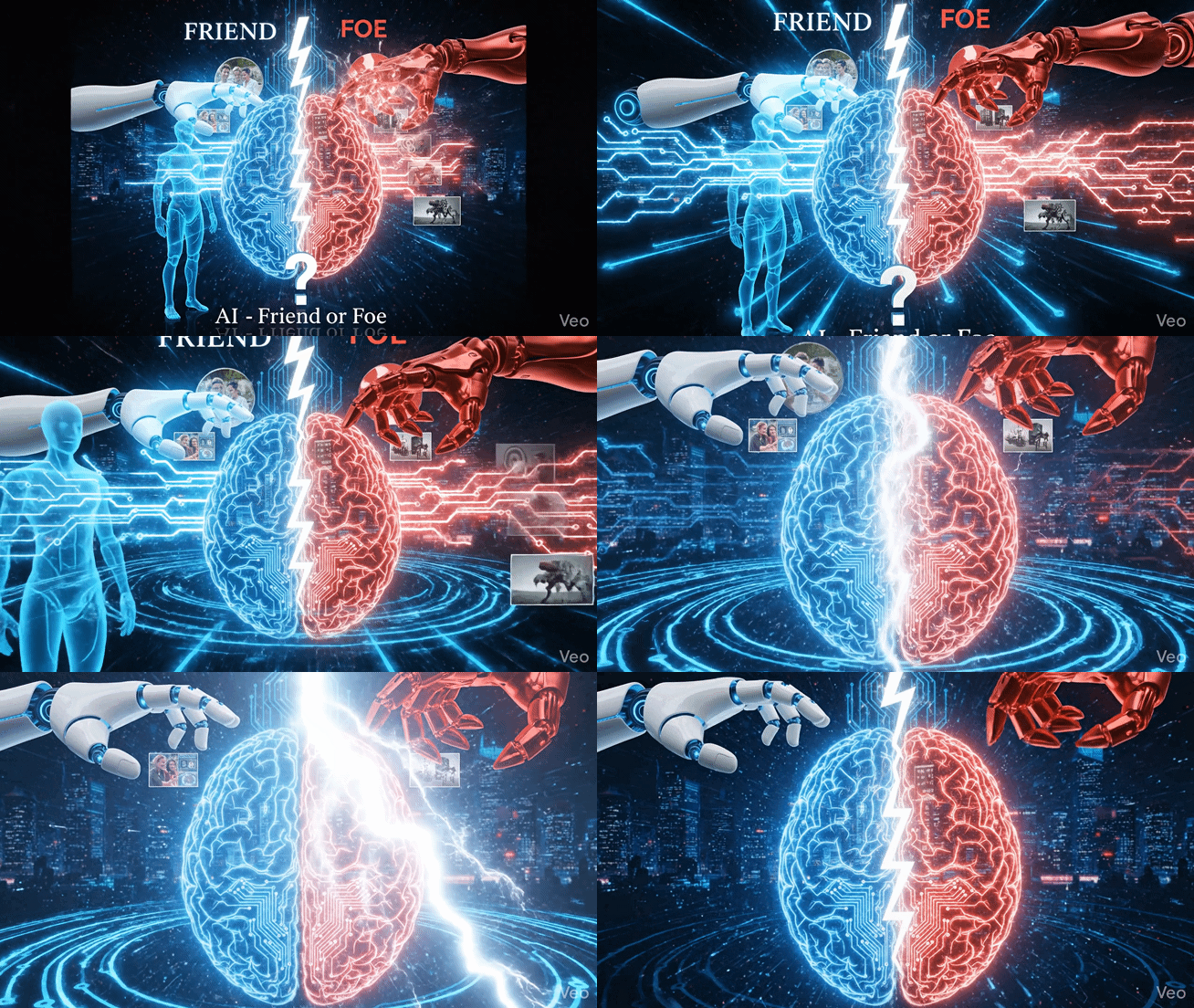
We present the data/controversy, you draw your own conclusion!
Understanding Artificial Intelligence: Evolution, Functionality and Future
The Reality of AI vs. Human Intelligence
When people hear “artificial intelligence,” they often picture movie scenes: machines holding conversations, solving complex problems, or acting with human-like emotions. It’s easy to assume AI thinks the way we do. It doesn’t. AI doesn’t imagine, reflect, or feel. It has no self-awareness or intentions. Instead, it possesses the ability to process massive datasets, follow complex logical rules, and detect patterns at a speed and scale far beyond human capability.
Key Concept: Data is to AI what experience is to people.
AI “thinks” by processing examples, detecting patterns, and learning from outcomes. It does not reason like a human; rather, it creates mathematical models based on what it has seen.
The History of Artificial Intelligence
The journey of AI spans from early mechanical calculations to the complex neural networks of today.
- Ancient Times: Invention of the abacus and early mechanical calculators—the first steps toward automating thinking.
- 1950: Alan Turing proposes the Turing Test to measure machine intelligence.
- 1956: The Dartmouth Workshop: John McCarthy coins the term "Artificial Intelligence," marking its birth as a scientific field.
- 1960s: Early programs like ELIZA (simulated conversation) and SHRDLU (manipulating objects in virtual space).
- 1970s–1980s: The AI Winters: Funding and interest decline due to unmet expectations.
- 1980s: Rise of Expert Systems (e.g., XCON), using predefined rules to mimic human decision-making.
- 1990s: Neural networks return and Machine Learning grows, shifting the focus from rigid rules to learning patterns from data.
- 2012: AlexNet wins the ImageNet competition, igniting the deep learning revolution.
- 2010s: Explosion of AI in Natural Language Processing (NLP) and computer vision; launch of models like GPT by OpenAI.
- 2020s: AI moves into real-world applications: self-driving cars, medical AI, and advanced chatbots.
- Present & Beyond: Focus on Multimodal AI, explainability, and ethical governance. AI is no longer an experiment—it is embedded in daily life.
Defining the AI Landscape: GenAI vs. AGI
Modern AI is generally categorized by its specific capabilities and its eventual goals. Understanding these distinctions helps clarify what AI can do today versus what remains science fiction.
Generative AI (GenAI)
Generative AI is a form of Narrow AI that excels at specific tasks. It creates new content—such as text, images, or computer code—by identifying and replicating patterns it has learned from its training data. While it produces novel and impressive outputs, its scope is limited to the specific domain it was trained on.
Artificial General Intelligence (AGI)
AGI is a theoretical future state of AI. Unlike today’s specialized models, AGI would possess human-level cognitive abilities, allowing it to understand, learn, and apply intelligence to any task or problem. AGI would offer broad, adaptable intelligence that mimics the flexible reasoning of a human being.
Conclusion
From Netflix recommendations to diagnostic tools in medicine, AI has moved from the laboratory to the center of the modern economy. While it lacks human consciousness, its ability to model the world through data makes it one of the most transformative tools of the 21st century.
Description
The image presents a visual dichotomy of Artificial Intelligence, split down the middle by a lightning bolt and a glowing brain.
- The Left Side ("FRIEND"): Features a smooth, welcoming white robotic hand and a glowing blue human hologram. The smaller inset images show people smiling and harmoniously collaborating using advanced technology and screens.
- The Right Side ("FOE"): Features a sharp, menacing red robotic claw. The inset images on this side depict militarized robot dogs, targeting systems, dark server rooms, and desolate landscapes.
Meaning
The artwork represents the ongoing societal debate regarding the dual-use nature of Artificial Intelligence. It visually contrasts the optimistic view of AI—as a helpful, collaborative tool that enhances human life—against the pessimistic fear of AI becoming a destructive, weaponized, or uncontrollable threat to humanity.
Here is an objective breakdown of the specific visual elements and the concepts they represent within the artwork:
Central Elements (The Core Debate)
- The Split Brain: The left hemisphere glows with a calm blue light, often associated with logic and technological stability. The right hemisphere pulses red, a color universally used to signal danger or aggression.
- Lightning Bolt & Question Mark: The jagged division emphasizes the polarizing nature of the topic, while the large question mark at the base highlights the ultimate uncertainty of AI's future trajectory.
The "FRIEND" Side (Left - Collaborative AI)
- White Robotic Hand: The design features smooth, rounded panels and an open, reaching gesture. It mirrors real-world collaborative robots (cobots) designed to safely operate alongside humans without causing injury.
- Blue Hologram Human: Represents the digital enhancement of humanity, potentially referencing concepts like "digital twins" used in personalized medicine or ergonomic research.
- Top Inset (Group with Tablet): Three smiling individuals sharing a transparent tablet. This visualizes AI's role in facilitating education, communication, and accessible information.
- Bottom Inset (Scientific Interface): Two women analyzing complex, glowing visual data. This highlights AI's current real-world applications in accelerating scientific research, data analysis, and medical diagnostics.
The "FOE" Side (Right - Destructive AI)
- Red Robotic Claw: Sharp, skeletal, and tightly angled. The knuckle joint features a distinct skull motif. This design relies on predatory imagery to symbolize autonomous systems that are hostile or lethal.
- Top Inset (Server Room): A dark, industrial server environment guarded by what appear to be robotic or heavily armored figures. This points to anxieties surrounding mass surveillance, corporate overreach, or autonomous systems protecting their own infrastructure.
- Middle Inset (Targeting System): An operator interacting with a robotic arm and a large bullseye interface. This represents the weaponization of AI, specifically lethal autonomous weapons systems (LAWS) and AI-assisted targeting.
- Bottom Insets (Militarized Quadrupeds): Two images showing four-legged, heavily armored robots—one carrying equipment and the other in a desolate, grey landscape. These draw direct parallels to modern military robotics, evoking fears of automated warfare and a dystopian future.
Here is a look at recent, verifiable polling data and research from institutions like Pew Research, Gallup, and Stanford University’s AI Index Report. The numbers show that public opinion is highly divided, mapping closely to the split imagery in your graphic.
The Broad Consensus: Change is Inevitable
Regardless of whether they view it as a friend or foe, the majority of the public agrees that AI is highly disruptive.
- 66% of people globally anticipate that AI will profoundly change their daily life in the next three to five years (Stanford AI Index / Ipsos).
- 59% of adults believe AI will have a greater historical impact than the smartphone, and 57% believe it will have a greater impact than the computer (Gallup, July 2025).
The "Friend" Perspective (Hopes & Benefits)
Globally, optimism is slowly rising, heavily driven by business adoption and younger demographics.
- 55% of individuals globally see AI products and services as more beneficial than harmful, a slight increase from 52% in 2022.
- 78% of organizations reported using AI in their business operations as of 2024, citing increased productivity and narrowed skill gaps.
- 36% of U.S. teens believe AI will have a positive personal impact on their lives over the next 20 years, frequently citing learning, research, and general efficiency as the primary benefits (Pew Research, Feb 2026).
The "Foe" Perspective (Fears & Concerns)
While global optimism is slightly up, specific anxieties regarding autonomy, job displacement, and societal impact are deepening, particularly in the United States.
- 47% of Americans believe the overall effect of AI on society will be negative—a share that grew steadily throughout 2024 and 2025.
- 59% of adults worry that AI will reduce the need for humans to perform important or creative tasks, rather than simply handling mundane chores (Gallup).
- 61% of Americans express fear of autonomous systems like self-driving cars, while only 13% trust them—mirroring the anxieties represented by the robotic imagery on the right side of your graphic.
- Declining Trust: Globally, confidence that AI companies will protect personal data fell to 47% in 2024, and fewer people believe AI systems are free from bias compared to previous years.
The Geographic Divide
The "friend or foe" debate changes dramatically depending on where you look in the world.
- High Optimism: Majorities believe AI offers more benefits than drawbacks in countries like China (83%), Indonesia (80%), and Thailand (77%).
- High Skepticism: In contrast, only a minority share that optimistic view in Canada (40%), the United States (39%), and the Netherlands (36%).
Here is a deep dive into the most recent, verifiable data regarding AI's impact on both the job market and education, highlighting the current realities of the "friend vs. foe" dynamic.
The Job Market: Displacement vs. Creation
The data reveals a workforce in transition, where the fear of automation directly competes with the promise of new industries.
- Net Job Growth (The "Friend"): The World Economic Forum’s (WEF) 2025 Future of Jobs report forecasts that while structural labor shifts could replace 92 million jobs by 2030, the technology is expected to create 170 million new roles. This results in a projected net global increase of 78 million jobs.
- Vulnerable Sectors (The "Foe"): Job displacement is heavily concentrated in specific sectors. Goldman Sachs and the Bureau of Labor Statistics note that roles most at risk of displacement include customer service representatives, accountants, bookkeepers, and administrative assistants.
- Worker Sentiment: According to a 2025 Statistics Netherlands (CBS) survey, 41% of people in paid employment believe their job could be done partly by AI, and 4% expect AI to take over their job completely. Among those who actually use AI at work, that number jumps to 56%.
- Economic Reality Check: Despite the rapid adoption, the immediate macroeconomic impact is debated. In early 2026, Goldman Sachs’ Chief Economist noted that AI investment has had a "basically zero" effect on direct US GDP growth thus far, suggesting the transition period may be longer and less immediately disruptive (or instantly profitable) than early 2024 models predicted.
Education: Efficiency vs. Integrity
Schools and universities are currently the most active testing grounds for AI adoption, showing stark contrasts in learning outcomes and academic integrity.
- Rapid Adoption: Usage has exploded over the last two years. An EdWeek Research Center survey released in January 2026 found that 61% of teachers use AI-driven tools in their classrooms, nearly double the 34% adoption rate from 2023. Similarly, student usage reached 86% during the 2024-2025 school year.
- Teacher Workload (The "Friend"): AI is proving highly effective at reducing administrative burdens. A Spring 2025 Gallup survey found that US teachers who use AI weekly save an average of 5.9 hours per week—the equivalent of roughly six weeks per school year.
- Academic Integrity (The "Foe"): Cheating remains the primary concern. A 2026 study from Youngstown State University reported that 66% of teachers have noticed an increase in plagiarism or AI misuse over the past year. Furthermore, 78% of teachers remain highly concerned about students using AI to cheat rather than learn.
- The Human Connection: The Center for Democracy and Technology (CDT) reported in late 2025 that 50% of students agree that using AI in class makes them feel less connected to their teachers, highlighting a hidden social cost to automated learning.
Here is a breakdown of recent, verifiable data from 2025 and early 2026 detailing how AI is reshaping healthcare, military defense, and the creative arts.
1. Healthcare & Pharmaceuticals: The High-Stakes Gamble
The medical field is seeing massive financial investment and rapid adoption of AI, but the technology is hitting a wall when it comes to late-stage clinical realities.
- Market Growth: The global AI in healthcare market is projected to reach $56.01 billion in 2026, with an expected growth rate (CAGR) of nearly 44% through the next decade (Fortune Business Insights, Feb 2026). As of 2026, 70% of healthcare and life science organizations report actively using AI (NVIDIA).
- The "Friend" (Efficiency & Accuracy): AI is demonstrably improving hospital workflows. A late 2025 study found that AI-generated operative reports achieved 87.3% accuracy, significantly outperforming surgeon-written reports, which sat at 72.8%. Furthermore, AI is cutting early-stage drug discovery and preclinical development timelines by 30% to 50%.
- The "Foe" (The Clinical Bottleneck): Despite the hype, AI is not a magic bullet for biology. As of December 2025, not a single AI-discovered drug had achieved FDA approval. While AI accelerates the early identification of compounds, it has fundamentally failed to improve the pharmaceutical industry’s historical ~90% clinical trial failure rate (Drug Target Review, Feb 2026).
2. Military & National Security: The New Arms Race
Driven by modern conflicts like the war in Ukraine, military budgets are aggressively shifting from traditional hardware toward autonomous systems, though public apprehension remains high.
- Market Growth: The global AI military market is projected to reach $22.41 billion in 2026. In the US alone, the Department of Defense requested approximately $1.8 billion specifically for AI and autonomy in its FY2025 budget.
- The "Friend" (Strategic Advantage): A late 2025 Gallup poll found that a plurality of Americans believe AI will mostly improve the military's ability to detect threats, analyze intelligence, and deploy weapons efficiently and safely.
- The "Foe" (Autonomous Escalation): The public is highly skeptical of taking humans out of the loop. 48% of Americans oppose the development of AI-enabled autonomous weapons for use in conflicts. Furthermore, 40% believe AI-enabled attacks from foreign governments are "very likely" to occur within the next two decades.
3. The Arts & Creative Industries: The Livelihood Threat
The creative sector is experiencing the most acute economic friction, caught between massive productivity gains for corporations and severe income threats for individual creators.
- Market Growth: The Generative AI market specifically within creative industries is valued at over $5 billion in 2026 and is expected to nearly triple by 2035 (Business Research Company).
- The "Friend" (The Wage Premium): For those adapting to the technology, the financial upside is clear. A June 2025 PwC Global AI Jobs Barometer found that jobs requiring AI skills offer an average wage premium of 56% over similar roles that do not. Furthermore, industries most exposed to AI saw three times higher growth in revenue per employee.
- The "Foe" (Income Collapse): For traditional creators, the outlook is grim. A February 2026 UNESCO report warned that generative AI is projected to drive significant income losses for artists by 2028. Specifically, music creators could see their revenues fall by 24%, and workers in the audiovisual sector may lose 21% of their income due to the saturation of AI-generated content in global markets.
But ultimately, the answer to the question "AI - Friend or Foe?", is the individuals opinion after weighing all the potential gains against the potential risks from his/hers interpertation and perspective.
.gif)
